
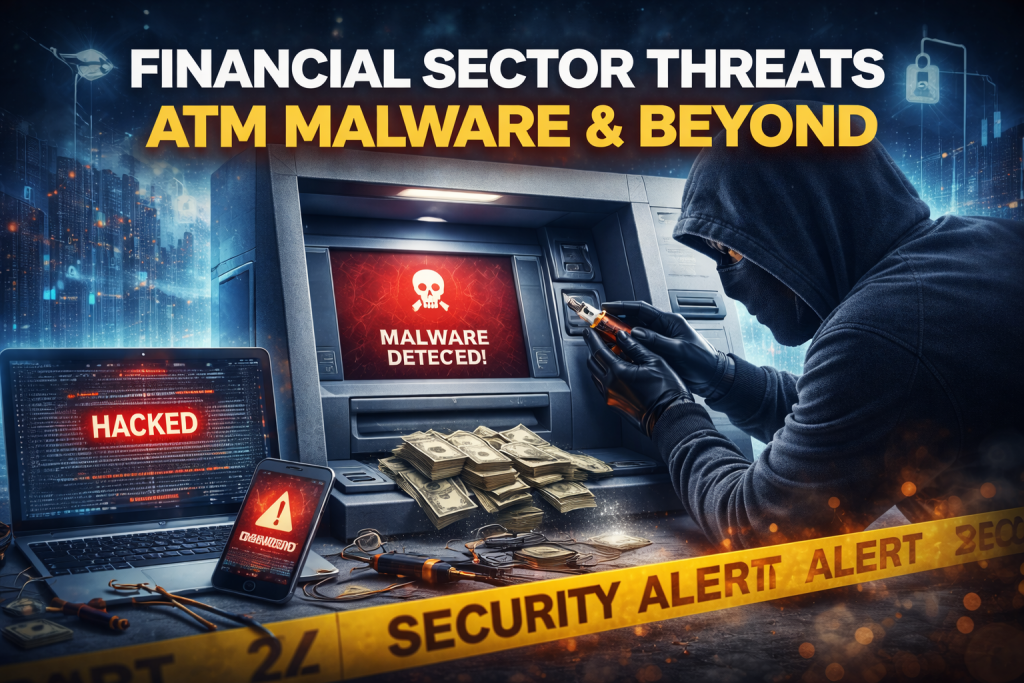
The financial sector has long been a prime target for cybercriminals due to the enormous value of its assets, the vast amounts of customer data it stores, and its critical role in global commerce. In 2025 and early 2026, we’ve seen several alarming trends — from malware that makes ATMs dispense cash to sophisticated attacks on banking systems and financial apps — underscoring that the battle for financial cybersecurity is far from over.
ATM Jackpotting: Malware That Makes Machines Dispense Cash
One of the most striking threats making headlines is ATM “jackpotting,” a type of malware attack where hackers compromise automated teller machines to force them to dispense cash without authorization.
Why This Matters
- Massive surge in attacks: Law enforcement agencies have reported hundreds of jackpotting incidents in the past year alone, contributing to millions of dollars in losses.
- Significant financial impact: These attacks directly affect banks and ATM operators.
- Unlike many cyberattacks that target customer accounts or data, jackpotting impacts the machines themselves, often without stealing individual credentials.
How Jackpotting Works
Threat actors typically gain physical access to an ATM by opening the maintenance panel. Once inside, they either infect the existing system or replace the hard drive with one containing malware.
One of the most well-known malware families used in these attacks targets the eXtensions for Financial Services (XFS) API, which controls communication between the ATM software and its hardware components. By exploiting this interface, attackers can issue unauthorized cash-dispense commands that bypass standard banking authorization processes.
Beyond ATM Malware: Broader Financial Cyber Threats
While ATM jackpotting is particularly dramatic, it represents only one segment of the growing cyber risk facing financial institutions.
Ransomware and Data Breaches
Ransomware remains a major threat to banks and financial organizations. These attacks can disrupt operations, encrypt sensitive customer data, and demand significant ransom payments. Beyond the immediate financial cost, institutions face reputational damage, regulatory scrutiny, and potential legal consequences.
Phishing and Social Engineering
Social engineering continues to be one of the most effective attack vectors. Criminals craft convincing emails, messages, and even voice-based attacks designed to trick employees or customers into revealing credentials or installing malware. As techniques become more sophisticated, detection becomes increasingly challenging.
API Exploits and Third-Party Vulnerabilities
Modern financial services rely on interconnected systems, open banking APIs, and third-party vendors. A vulnerability in a single partner’s system can create an entry point into a broader banking environment. Supply chain and vendor risk management are now central components of financial cybersecurity strategy.
Mobile and App-Based Malware
With the rapid growth of digital banking, attackers increasingly target mobile devices and financial applications. Some malware variants use screen overlays, session hijacking, or remote control capabilities to capture login credentials and authorize fraudulent transactions without the user’s knowledge.
Defense Strategies: Strengthening Financial Cybersecurity
Financial institutions are investing heavily in security modernization, but evolving threats require continuous adaptation.
Layered Security Architecture
Adopting zero-trust models, enforcing strong multi-factor authentication, and implementing network segmentation can significantly reduce exposure across users, devices, and systems.
Real-Time Threat Detection
Advanced monitoring systems and AI-driven analytics help identify anomalies such as unusual cash-dispense activity, irregular login patterns, or suspicious API calls before they escalate into major incidents.
Physical and Endpoint Hardening
To mitigate ATM jackpotting risks specifically, institutions should:
- Strengthen physical locks and tamper detection mechanisms
- Disable unnecessary ports such as USB access
- Monitor systems for unauthorized software installations
- Maintain strict patch management and firmware updates
These steps reduce the attack surface for physical and software-based compromise.
Cross-Sector Collaboration
Information sharing between financial institutions, cybersecurity vendors, and law enforcement agencies plays a crucial role in threat mitigation. Rapid dissemination of indicators of compromise (IOCs) allows organizations to respond proactively rather than reactively.
Final Thoughts: A Persistent and Evolving Threat Landscape
The financial sector’s digital transformation has improved efficiency, accessibility, and customer experience. However, it has also expanded the attack surface.
From ATM malware to ransomware, API exploits, and mobile banking threats, financial institutions face a dynamic and persistent risk environment. Cybersecurity must be treated not merely as an IT function, but as a strategic business priority essential to preserving trust and maintaining the stability of the global financial system.