
Firewalls, encryption, and AI-powered detection tools continue to improve—but cybercriminals are increasingly bypassing technology altogether. Instead, they are targeting the human element.
In 2026, human factors and social engineering remain among the most effective and damaging attack vectors. Modern attacks exploit trust, urgency, and authority—often enhanced by AI—to manipulate people into doing what attackers want.
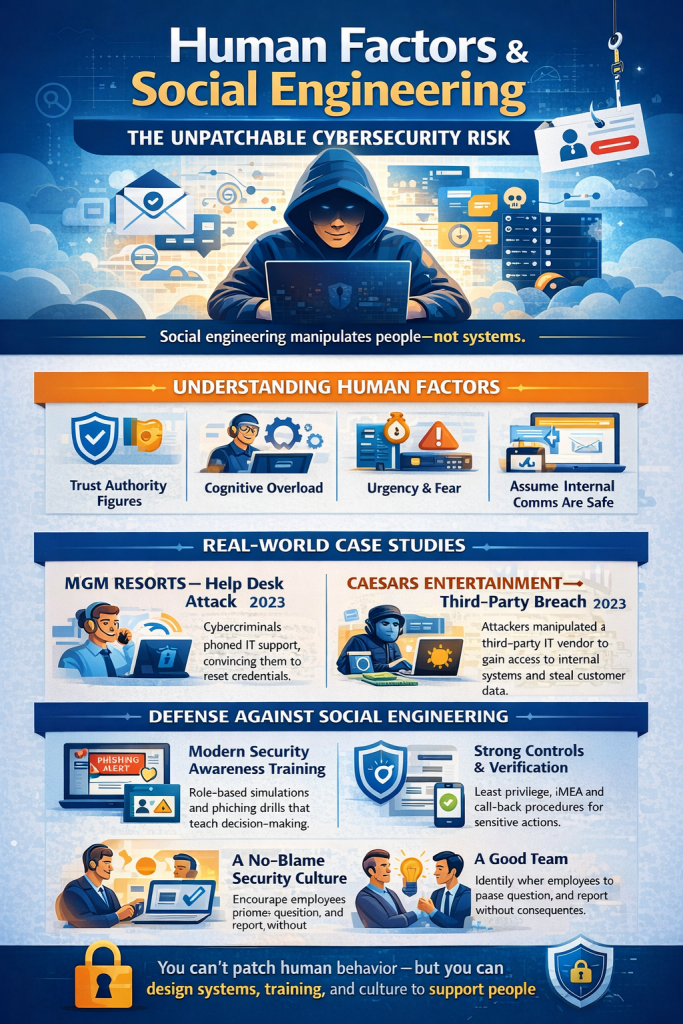
Understanding Human Factors in Cybersecurity
Human factors refer to how people think, behave, and make decisions—especially under pressure. In cybersecurity, attackers exploit:
- Trust in familiar names, brands, and authority figures
- Cognitive overload and multitasking
- Fear, urgency, and curiosity
- Assumptions that internal communications are safe
Social engineering doesn’t break systems—it convinces people to open the door.
How Social Engineering Has Evolved
Today’s social engineering attacks are more targeted, convincing, and automated than ever before.
Common modern techniques include:
- Spear-phishing: Personalized emails crafted using stolen or scraped data
- Vishing & smishing: Voice and SMS attacks that exploit urgency
- Business Email Compromise (BEC): Trusted business workflows abused for fraud
- AI deepfakes: Audio and video impersonation of executives or colleagues
Real-World Case Studies: When Human Factors Are Exploited
MGM Resorts – Help-Desk Social Engineering (2023)
Attackers reportedly gained access by calling the IT help desk and impersonating an employee, successfully convincing staff to reset credentials. The breach caused widespread system outages across hotels and casinos, highlighting how identity systems and support workflows can be exploited through simple human interaction.
Lesson: Help desks are high-risk targets and require strict identity verification and escalation procedures.
Caesars Entertainment – Third-Party Social Engineering (2023)
Attackers socially engineered an outsourced IT vendor to gain access to Caesars’ internal systems, leading to the theft of customer loyalty program data. The breach demonstrates how attackers often target the weakest link in the supply chain, not the primary organization.
Lesson: Third-party vendors must follow the same security and training standards as internal teams.
Deepfake Executive Video Call Fraud – Hong Kong (2024)
In one of the most striking examples of AI-enabled social engineering, an employee joined a video meeting where every “participant,” including the CFO, was an AI deepfake. Believing the request was legitimate, the employee authorized approximately $25 million in transfers.
Lesson: Visual confirmation is no longer proof of authenticity. High-risk actions must require multi-party, out-of-band verification.
Twilio – SMS Phishing Attack (2022)
Employees were tricked by SMS messages that led them to a fake login page, allowing attackers to harvest credentials and access internal systems. This ultimately impacted customer data for several organizations relying on Twilio.
Lesson: Even security-aware employees can fall victim under time pressure—technical controls must assume occasional human error.
Why Human-Centric Attacks Keep Working
These incidents succeed because:
- Humans are trained to respond quickly and be helpful
- Attackers create artificial urgency (“this must be done now”)
- Trust is assumed in internal communications
- People fear consequences of delaying executive requests
Technology rarely fails—people are manipulated into bypassing it.
Defending Against Human Factors & Social Engineering
Modern Security Awareness Training
- Short, frequent, role-specific training
- Simulations that include phishing, vishing, and deepfake scenarios
- Focus on decision-making, not just recognition
Stronger Identity & Workflow Controls
- Multi-factor authentication everywhere
- Least-privilege access
- Mandatory secondary approval for financial or access changes
Out-of-Band Verification
- Call-back procedures using known phone numbers
- Separate channels for approving sensitive requests
Behavior-Based Detection
- Monitor for unusual login locations, times, or behavior
- Flag changes in payment workflows or communication tone
Build a No-Blame Security Culture
- Encourage employees to pause, question, and report
- Reward early reporting—even if it turns out to be a false alarm
The Road Ahead
As AI continues to improve, social engineering attacks will become more convincing, scalable, and difficult to detect. Organizations that treat human behavior as a core security concern—rather than a training checkbox—will be far more resilient.
Key Takeaway
You can’t patch human behavior—but you can design systems, training, and culture that support people when it matters most. Build strong controls/processes, train folks to adhere to them, and test them frequently.